

Short answer: Boston Terriers were bred to be refined American companion dogs — small enough for city life, sturdy enough for an active household, and friendly enough to belong in the parlor of a Boston family. Their ancestors came from bulldog-and-terrier dogs with fighting ancestry, but the Boston Terrier itself was deliberately refined into something very different: a compact, polite, people-loving house dog.
That’s where the confusion starts. The popular idea that “Boston Terriers were bred for pit fighting” is one of the most repeated half-truths about the breed. The real answer is more nuanced — and honestly, much more interesting.
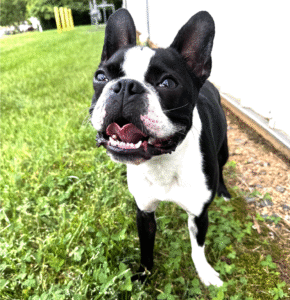
I’m Dzmitry, and my Boston Terrier Dumpling has been my running buddy, lap-warmer, and four-legged comedian for years. Looking at him snore on the couch in his little tuxedo, you’d never guess his great-great-great-grandfather weighed around 32 pounds and looked far more like a sturdy bull-and-terrier dog than the compact little American Gentleman sleeping in my house today.
So let’s get into the real story.
What Were Boston Terriers Bred For? One-Sentence Answer
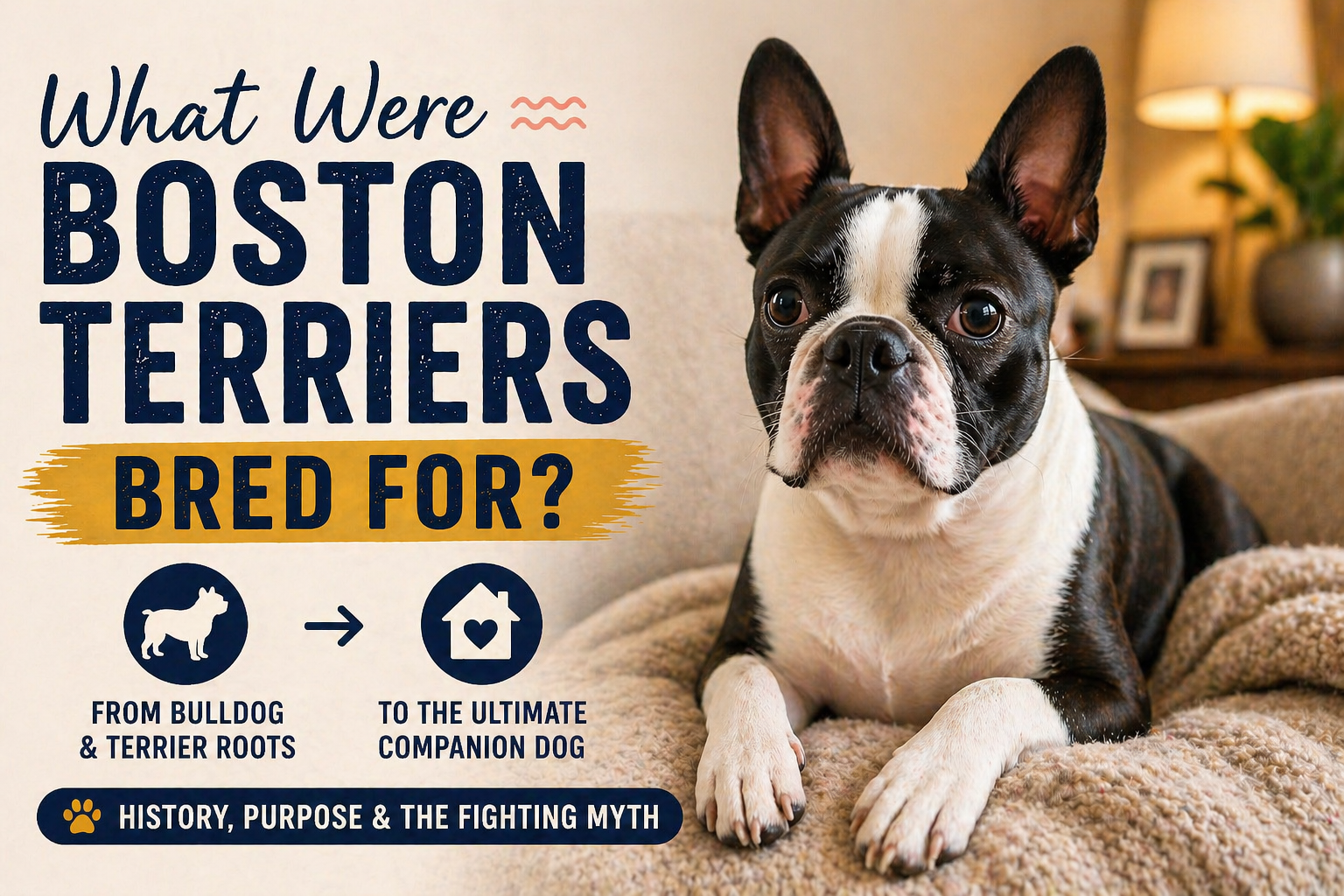
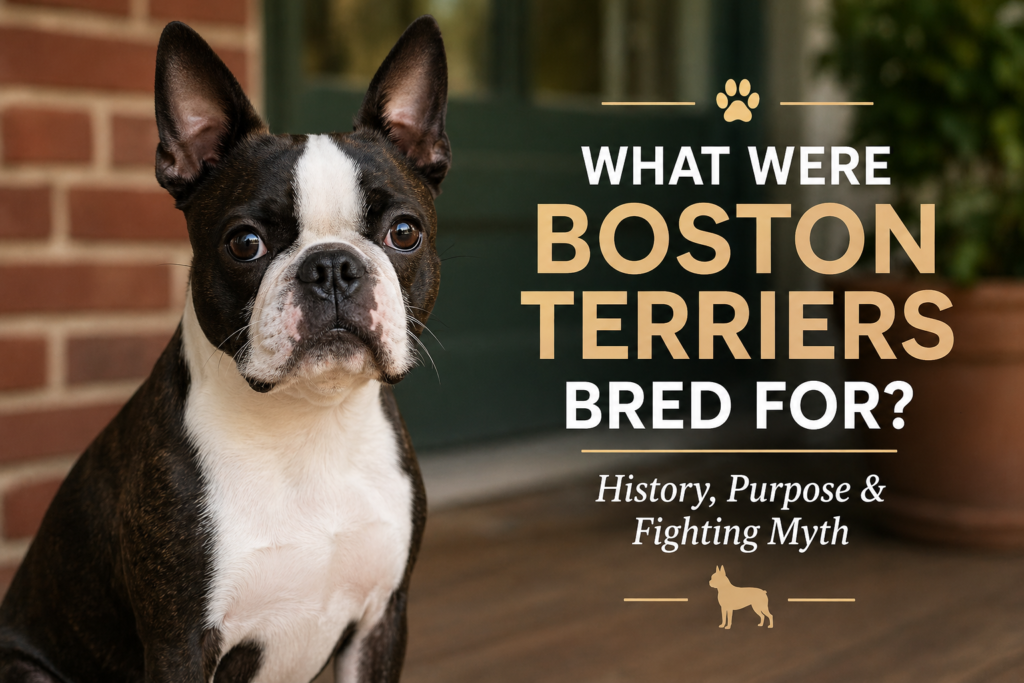
Boston Terriers were bred to be small, stylish companion dogs in Boston, Massachusetts — developed from bulldog-and-terrier ancestors, then refined over several decades for friendly temperament, compact size, and life as an American house dog.
That’s the short, accurate version.
The longer version explains why so many articles get this wrong.
Bred From vs. Bred For: The Difference Most Articles Miss
The easiest way to understand Boston Terrier history is to separate three things that often get blurred together.
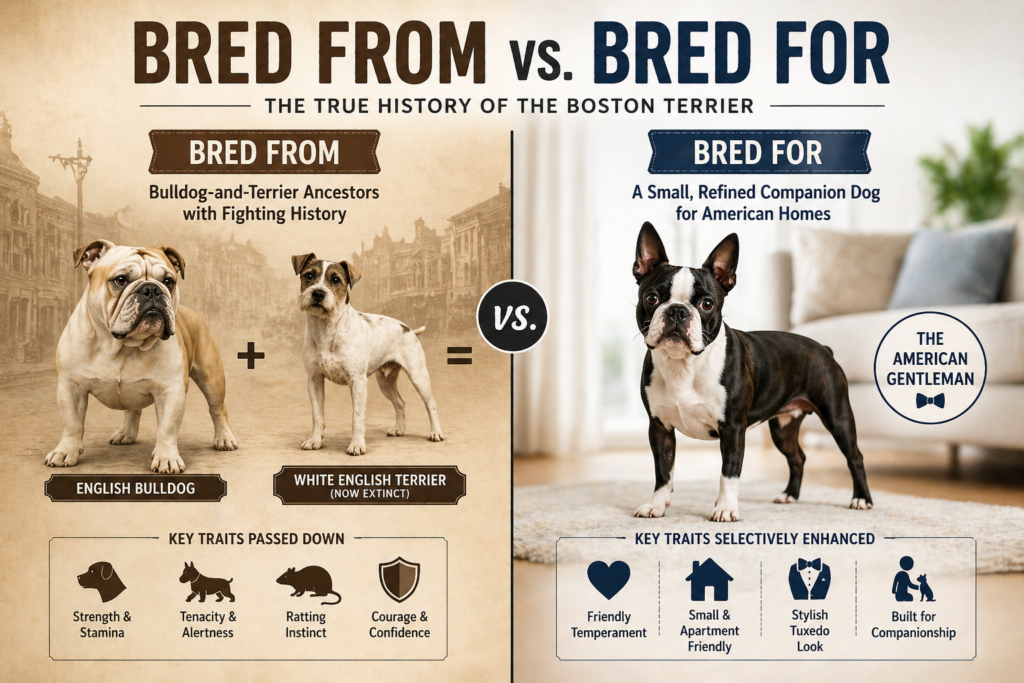
- Bred from: Bulldog-and-terrier dogs with fighting ancestry in 19th-century England.
- Bred for: A smaller, cleaner, friendlier companion dog for Boston homes.
- Refined into: The “American Gentleman” — a compact, polite, tuxedo-marked house dog officially recognized by the AKC in 1893.
That distinction matters.
Saying Boston Terriers came from fighting-stock dogs is historically fair. Saying the modern Boston Terrier breed was created mainly for pit fighting is too simple — and the early breed records do not really support it.
The truth is this: Boston Terriers were born from the old bulldog-and-terrier world, but they were shaped into something gentler, smaller, more social, and more suitable for life beside people.
In other words, they were not designed to be pit dogs.
They were designed to become companions.
Quick Takeaway for Boston Terrier Owners
If you own a Boston today, your dog’s compact body, tuxedo markings, expressive face, and people-loving personality are not accidents.
They are the result of generations of breeding toward one main goal: a friendly American companion dog.
That’s why your Boston wants to sit beside you, follow you from room to room, sleep under a blanket, supervise your snacks, and act like your tiny emotional support manager. Dumpling takes this job very seriously — especially the snack supervision part.
Where Boston Terriers Came From
To understand what Boston Terriers were bred for, you first need to know what they were bred from.
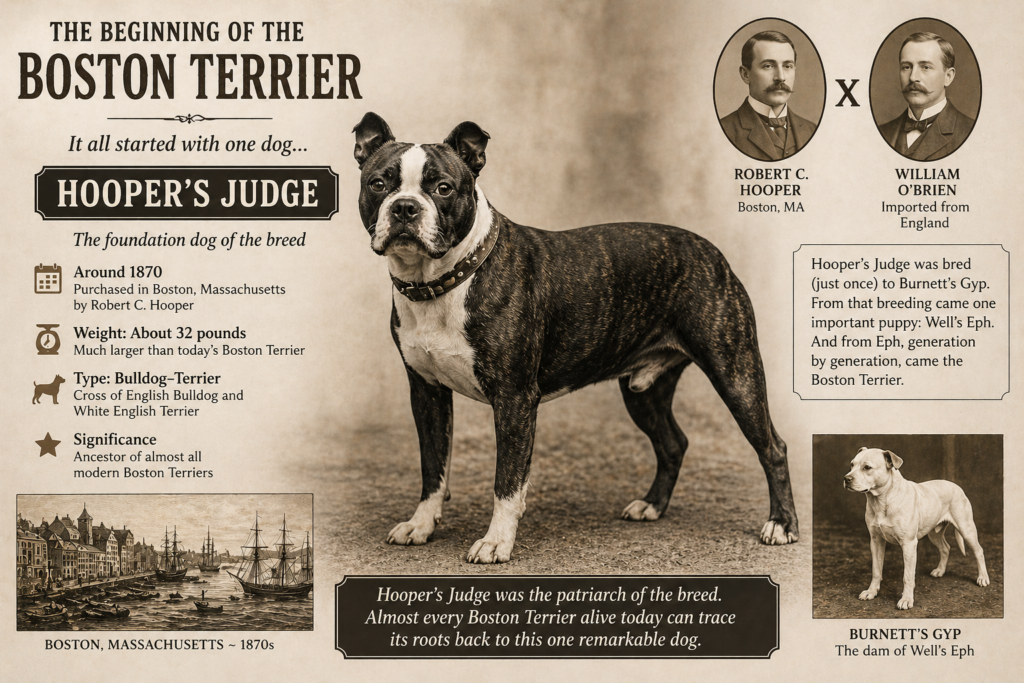
The breed traces back to one famous dog: Hooper’s Judge.
Around 1870, a Boston man named Robert C. Hooper bought Judge from William O’Brien, who had imported him from England. According to the Boston Terrier Club of America, Judge was a cross between an English Bulldog and a White English Terrier, a breed that is now extinct.
Judge was not the tiny Boston Terrier we know today. He was a stocky, dark-brindle dog with a square head, a white blaze, and a weight of about 32 pounds. In other words, he looked much closer to a small bull-and-terrier type dog than to the 12–25 pound Boston Terrier standard we recognize now.
Judge was bred to Burnett’s Gyp, a 20-pound white bulldog-type female owned by Edward Burnett of Southboro, Massachusetts.
From that breeding came one important puppy: Well’s Eph.
And from Eph, generation by generation, came the dog we now call the Boston Terrier.
If you want the full breeding chain — Hooper’s Judge, Burnett’s Gyp, Well’s Eph, Tobin’s Kate, Barnard’s Tom, and the other early dogs — I cover that in detail in my guide on how Boston Terriers were bred.
This article answers a different question.
Not how they were made.
But why they were made.
What Were Boston Terriers Actually Bred For?
Boston Terriers were bred to be the first great American small companion dog — a homegrown alternative to the European parlor dogs that were popular in American homes during the 1800s.
The goal was not to create another working fighter.
The goal was to create a compact, stylish, good-natured dog that could live close to people.
Early Boston Terrier breeders wanted a dog that could:
- Live comfortably in a Boston townhouse or apartment
- Be small enough for the home, but sturdy enough for daily walks
- Have the gentle temperament of a parlor pet
- Look refined and “dapper” with clean markings and a short coat
- Be alert without being noisy
- Be sociable rather than quarrelsome
- Feel unmistakably American at a time when many popular breeds came from Europe
That last point matters more than people realize.
The Boston Terrier became one of America’s signature homegrown breeds, and the American Kennel Club registered the first Boston Terrier in 1893.
The breed was, in a way, a point of civic pride. Boston had created its own dog — small, stylish, well-mannered, and charming enough to earn the nickname “The American Gentleman.”
That nickname was not random.
It reflected the very thing breeders were trying to create.
The “Pit Fighting” Myth, Explained
If you have searched this topic before, you have probably seen the claim that Boston Terriers were “originally bred for pit fighting.”
This appears in many places, including some otherwise reputable breed summaries. But the reality is more layered.
The Short Version of the Myth
Here is the cleanest way to say it:
Boston Terriers had fighting-type ancestors, but the Boston Terrier breed itself was refined as a companion dog.
Hooper’s Judge came from English bulldog-and-terrier stock. Dogs of that type were historically associated with bull-baiting, ratting, and dog fighting in 19th-century England.
That part is true.
But the Boston Terrier developed in Boston during a period when breeders were moving in a different direction. By the late 1800s, formal dog shows were becoming more popular, the American Kennel Club was being established, and Boston breeders were increasingly selecting dogs for appearance, size, temperament, and companionship.
That is a very different purpose from pit fighting.
Early Boston Terrier histories describe the breed through its foundation dogs, size, markings, and temperament — not as a purpose-built pit-fighting breed.
Why the Fighting Myth Sticks
So why does the myth stick?
There are three big reasons.
- People confuse “bred from” with “bred for.”
Boston Terriers came from bulldog-and-terrier ancestry, but ancestry is not the same thing as purpose. - Early Bostons still had terrier instincts.
They could chase, catch rats, and act bold around other animals. That does not mean organized fighting was the breed’s main purpose. - The story sounds dramatic.
“Tiny tuxedo dog with a secret fighting past” is more clickable than “small American companion dog developed from mixed bulldog-and-terrier stock.”
The fair summary is this:
Boston Terriers came from the old fighting-dog world, but they were bred away from it.
And that is exactly what you see in modern Bostons.
They still have confidence. Many still have stubbornness. And yes, they still have a little spark.
But their real talent is living with people.
Dumpling may bark at the vacuum cleaner like it owes him money, but at heart, he is exactly what Boston breeders were aiming for: a sturdy little companion with a big personality.
What Jobs Did Boston Terriers Actually Do?
Once the breed existed, Boston Terriers filled several roles. But organized fighting was not the job that defined them.
Their real working résumé looks very different.
1. Companion Dog
This was always the main job.
Boston Terriers were created to live closely with people. They were meant to be small enough for indoor life, clean enough for the home, and friendly enough to belong around families.
That companion role is still the heart of the breed today.
A Boston Terrier wants to be involved. Cooking dinner? He is there. Folding laundry? He is supervising. Sitting down for five quiet minutes? He has already claimed half your lap.
This is not an accident.
It is the breed doing exactly what it was built to do.
2. Ratter
Boston Terriers were not primarily bred as ratting dogs, but their terrier ancestry gave them quick reflexes and a prey drive.
Some early Bostons likely helped keep rats away from stables, kitchens, and shops. That was common for many small, quick dogs in city environments.
You can still see flashes of it today.
Dumpling, for example, can ignore me calling his name three times in the house, but if a squirrel blinks 200 feet away, suddenly he becomes a highly trained surveillance officer.
That little terrier spark is still in there.
It just lives inside a companion dog.
3. Watchdog
Boston Terriers are often alert without being constantly noisy.
They notice movement. They hear the door. They know when a delivery driver has committed the serious crime of approaching the porch.
But they are not supposed to be frantic barkers. A good Boston is more like a compact doorbell with opinions.
This made them useful in apartments, townhouses, and smaller homes where people wanted an alert little dog without the chaos of constant barking.
4. Show Dog
Dog shows became increasingly popular in the late 1800s, and Boston breeders had something exciting: a homegrown American breed.
The Boston Terrier’s clean markings, compact body, square head, and lively expression made it a natural fit for the show ring.
Conformation showing helped standardize the breed and shaped the look we recognize today — the short coat, the tuxedo markings, the compact frame, and the alert expression.
5. Therapy and Sport Dog
Modern Boston Terriers are still companion dogs first, but many also do well in therapy work and dog sports.
You can find Bostons in:
- Agility
- Rally
- Obedience
- Flyball
- Therapy dog visits
- Emotional support roles
Their friendliness, humor, and people-focused nature make them well suited for jobs that require connection rather than intimidation.
They are not built to guard a junkyard.
They are built to win over a room.
Fun Historical Note: Mascots, Icons, and Sergeant Stubby
Boston Terriers later became cultural icons too.
Boston University students voted for the Boston Terrier as the school mascot in 1922. Massachusetts also named the Boston Terrier its official state dog in 1979. And during World War I, a Boston-type stray named Sergeant Stubby became one of the most famous military dogs in American history.
But these were cultural roles, not the reason the breed was created.
They show how beloved Boston Terriers became after the breed had already established itself as a charming, brave, and people-oriented companion.
How Selective Breeding Shaped Boston Terriers for Companionship
If the goal was a refined companion dog, the breeding choices make sense.
Over several decades, Boston Terrier breeders shaped the breed in specific ways.
They Made the Breed Smaller
Hooper’s Judge weighed about 32 pounds.
The modern AKC standard places Boston Terriers in weight classes from under 15 pounds up to not exceeding 25 pounds.
That change matters. Breeders were not trying to create a larger, more powerful fighting dog. They were moving toward a compact dog that could live comfortably inside the home.
Smaller size made the breed easier to manage, easier to house, and better suited for city living.
They Selected for a Calmer Temperament
The Boston Terrier’s purpose depended on temperament.
A companion dog cannot be constantly quarrelsome, difficult to handle, or unsafe around people. Friendly, manageable dogs fit the role. Over time, breeders favored dogs that were social, lively, and easier to live with.
That is one reason modern Boston Terriers are known for being affectionate, funny, and people-focused.
They can be stubborn. Absolutely.
But aggressive by design? No.
They Standardized the “Tuxedo” Look
The Boston Terrier’s famous tuxedo markings were not just a cute accident.
The AKC standard describes the breed’s accepted colors and required white markings, including the white muzzle band, white blaze, and white forechest.
That formal look helped create the breed’s “American Gentleman” identity.
A Boston looks like he dressed for dinner and then immediately tried to steal your sandwich.
They Created a Distinctive Head and Expression
Boston Terriers became known for their square head, short muzzle, large eyes, and expressive face.
That look is one of the reasons people fall in love with the breed. A Boston Terrier can communicate an entire paragraph with one sideways glance.
But this also comes with responsibility.
Because Boston Terriers are brachycephalic dogs, modern owners and breeders have to pay close attention to breathing, heat sensitivity, eye health, and overall structure. I cover those issues more deeply in my guide to Boston Terrier health and lifespan.
A good modern Boston should not just look cute.
He should be able to breathe, move, play, and live comfortably.
They Preserved the Short Tail
The Boston Terrier’s short tail is another breed feature that developed early and became part of the standard look.
Some Bostons have a straight short tail. Others have a screw tail or natural bobtail. Either way, that compact rear-end silhouette became part of the breed’s identity.
And yes, it contributes to the famous Boston Terrier wiggle.
The tail may be tiny.
The attitude is not.
What Are Boston Terriers Bred For Today?
Modern Boston Terriers are still bred for companionship.
The job description has not changed that much.

Today, responsible breeders focus on producing Boston Terriers that are:
- Friendly family companions
- Adaptable apartment and city dogs
- Good-natured with people
- Comfortable around children when properly socialized
- Suitable for the show ring under the AKC Non-Sporting Group
- Healthy enough to breathe, move, and live well
- Stable in temperament
- Structurally sound
The biggest difference between then and now is health awareness.
Early breeders focused heavily on type, size, markings, and temperament. Modern responsible breeders also have to think carefully about:
- Brachycephalic airway concerns
- Eye problems
- Patellar luxation
- Heart issues
- Heat sensitivity
- Overall structure and mobility
A 21st-century Boston Terrier should still be the American Gentleman — but a healthier, more carefully bred version of one.
That means a dog who can cuddle on the couch, walk around the neighborhood, play in short bursts, and live a comfortable life as part of the family.
So, Were Boston Terriers Bred for Fighting or Companionship?
The most accurate answer is:
Boston Terriers were bred from dogs with fighting ancestry, but they were refined into companion dogs.
Their roots are tough.
Their purpose is domestic.
That is the part many short breed summaries miss.
The Boston Terrier is not a fighting dog that accidentally became cute. It is a companion breed created from rougher ancestors and softened through selective breeding into a smaller, friendlier, more polished American house dog.
That is why the breed can be both bold and cuddly.
It can be sturdy and sensitive.
It can be stubborn and sweet.
And somehow, it can be both little clown and little gentleman.
Honestly, that mix is exactly why Boston Terrier people love them so much.
Final Thoughts From Me and Dumpling
The honest answer to “what were Boston Terriers bred for?” takes a little more care than the usual one-line answer.
They came from bulldog-and-terrier dogs with a tougher past.
But they were bred for something much gentler.
Boston Terriers were refined into one of America’s great companion breeds — small enough for the city, sturdy enough for daily life, and friendly enough to be welcome almost anywhere.
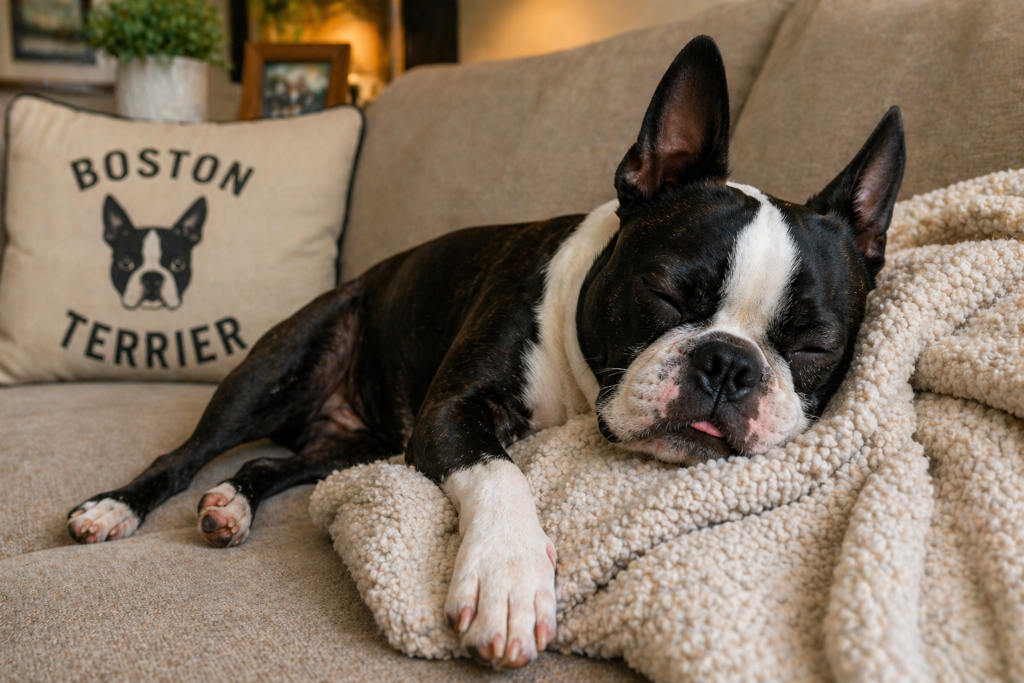
When I look at Dumpling stretched out on the couch, snoring like a tiny tuxedoed lawnmower, I do not see a fighting dog.
I see exactly what those early Boston breeders were trying to create: a compact, funny, loyal little companion who wants to be wherever his people are.
They got it right.
If you enjoyed this, you might also like my deep dive on how Boston Terriers were bred and my piece on why Boston Terriers are the best family dogs.
Give your Boston a scratch behind the ears from Dumpling. 🖤🤍
Boston Terrier Breeding History FAQ
-
Were Boston Terriers really bred for fighting?
Not in any direct sense. Their ancestors included bulldog-and-terrier dogs associated with fighting history, but the Boston Terrier itself was developed in the 1870s and refined as a companion dog. Early breed histories describe a dog selected for temperament, size, appearance, and suitability for life around people — not for organized fighting.
-
Why are Boston Terriers called the "American Gentleman"?
Boston Terriers are called the American Gentleman because of their tuxedo-like markings and their polite, companionable temperament. The nickname fits the breed’s original purpose: a stylish, compact, well-mannered American house dog.
-
What two breeds make a Boston Terrier?
The foundation dog, Hooper’s Judge, was described as a cross between an English Bulldog and a White English Terrier. Later breeders refined the line over several generations to create the smaller, cleaner, more companionable Boston Terrier we know today.
-
Are Boston Terriers terriers or non-sporting dogs?
Boston Terriers have terrier ancestry, but the AKC classifies them in the Non-Sporting Group, not the Terrier Group. They were developed mainly for companionship, not for traditional terrier work like going to ground after vermin.
-
Were Boston Terriers ever used for ratting?
Some early Bostons did kill rats around stables and homes, and the breed retains a strong prey drive. But ratting was a side benefit, not the breeding goal. -
Who is the ancestor of all Boston Terriers?
The breed traces back to Hooper’s Judge, a dog owned by Robert C. Hooper of Boston around 1870. Judge was a bulldog-and-terrier type dog and is considered the foundation ancestor of the Boston Terrier breed.
-
Are Boston Terriers good family dogs today?
Yes. Boston Terriers are usually affectionate, playful, people-focused dogs, which makes them excellent family companions when properly socialized and cared for. That friendly temperament is not random — it is the result of generations of breeding toward companionship.
-
What are Boston Terriers bred for now?
Today, Boston Terriers are bred mainly as companion dogs. Responsible breeders also focus on health, structure, temperament, and breed type so modern Bostons can live happy, comfortable lives as family pets.